Written by:


As the gates open at this year’s RHS Chelsea Flower Show, Project Giving Back is reflecting on five years of funding gardens for good causes at the show. In all, 63 gardens supported by PGB are now relocated in communities around the UK.To help celebrate its final year, and to create a space for conversation about the future of creative philanthropy in the UK, Project Giving Back has a garden of its own. Kendra Wilson spoke to designer James Basson, along with PGB’s CEO Hattie Ghaui, to find out more.
May 17, 2026
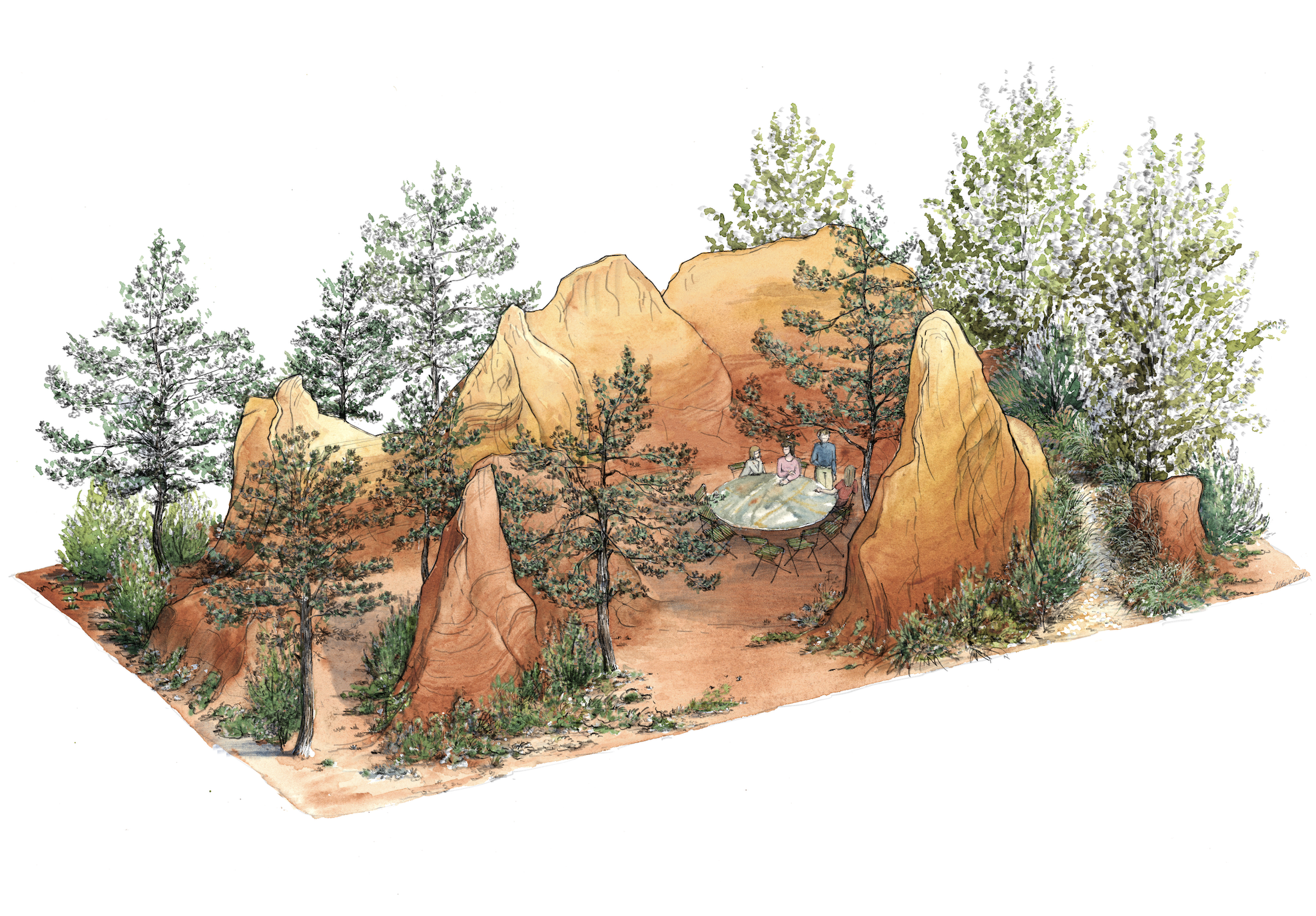
The RHS Chelsea Flower Show has a way of grabbing the nation's attention, yet one of its most key players in recent times has never yearned for the spotlight. As a grant-making charity, Project Giving Back is busy promoting the good causes of other charities — as well as the horticulture industry — on the generous stage that is RHS Chelsea. In its fifth and final year at the show, PGB can be forgiven for doing a bit of throat-clearing, in presenting its own garden. Being talked about is part of it, but the Project Giving Back Garden is also a celebration of its achievements in creative philanthropy, through the prism of a memorable garden. Designed by returning Chelsea virtuoso James Basson and featuring red, sandy cliffs at five metres high, it is located at the top of Main Avenue and will be hard to miss.
James Basson took away a gold medal and Best in Show from his last outing at Chelsea in 2017, and like other designers who have aced it, he wasn't thinking of returning. But the idea of "giving back" has been a draw for an impressive array of Chelsea stars, persuaded by PGB's funding model that is tied to the relocation of every show garden, for a lasting impact on communities. Who can forget Cleve West's 2023 return, with an emotive, 'abandoned' garden for Centrepoint? The charity, and garden, still see his active engagement.
James lives and works in Provence, making gardens that are integrated into the needs of the local landscape; if there is no natural water source, then the garden is designed not to require water. The inspiration for his Chelsea garden is a place in Roussillon, a post-industrial, former mine for extracting ochre pigment. "Humans have been there, they've done their thing, and then the land is recovering," explains James. "And what's remarkable is that it's recovering really fast." The rocks there are relatively soft, eroding in interesting ways. "Within 60 years, the whole thing has become a kind of amorphic shape that is really extraordinary."
Within this dry landscape there is a lot of diversity, which will be reflected in the show garden. In the original location that was James' first inspiration, plants are dense where there is more shade, thinning out to nothing in exposed, sandier areas, and there is a garden within that. "It's a gardened piece of landscape, near a house," he says. "It's a little gem, that someone goes into every now and then and just kind of harbours the vegetation, to make enough room for a table and chairs, and a place to be within this extraordinary landscape."

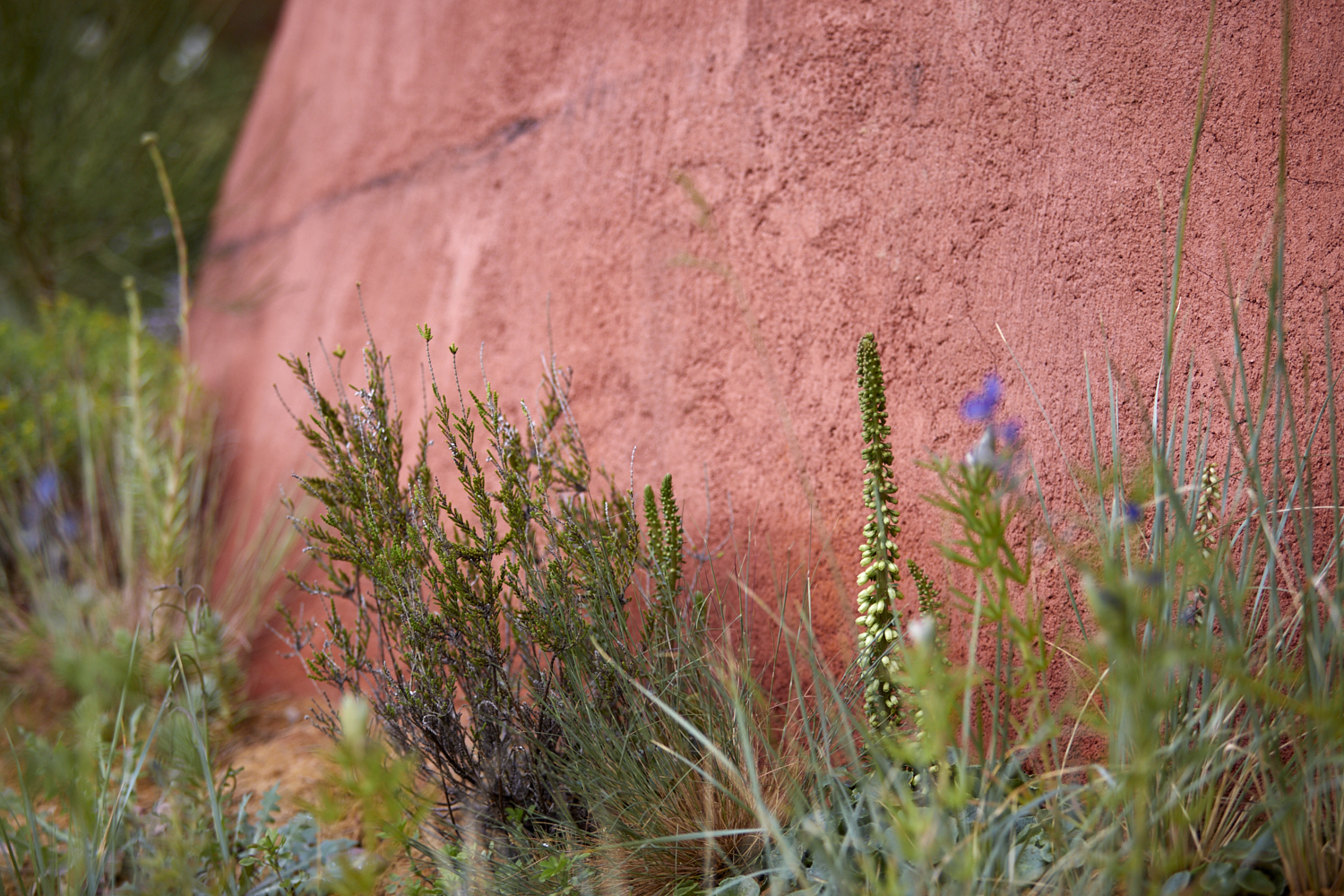
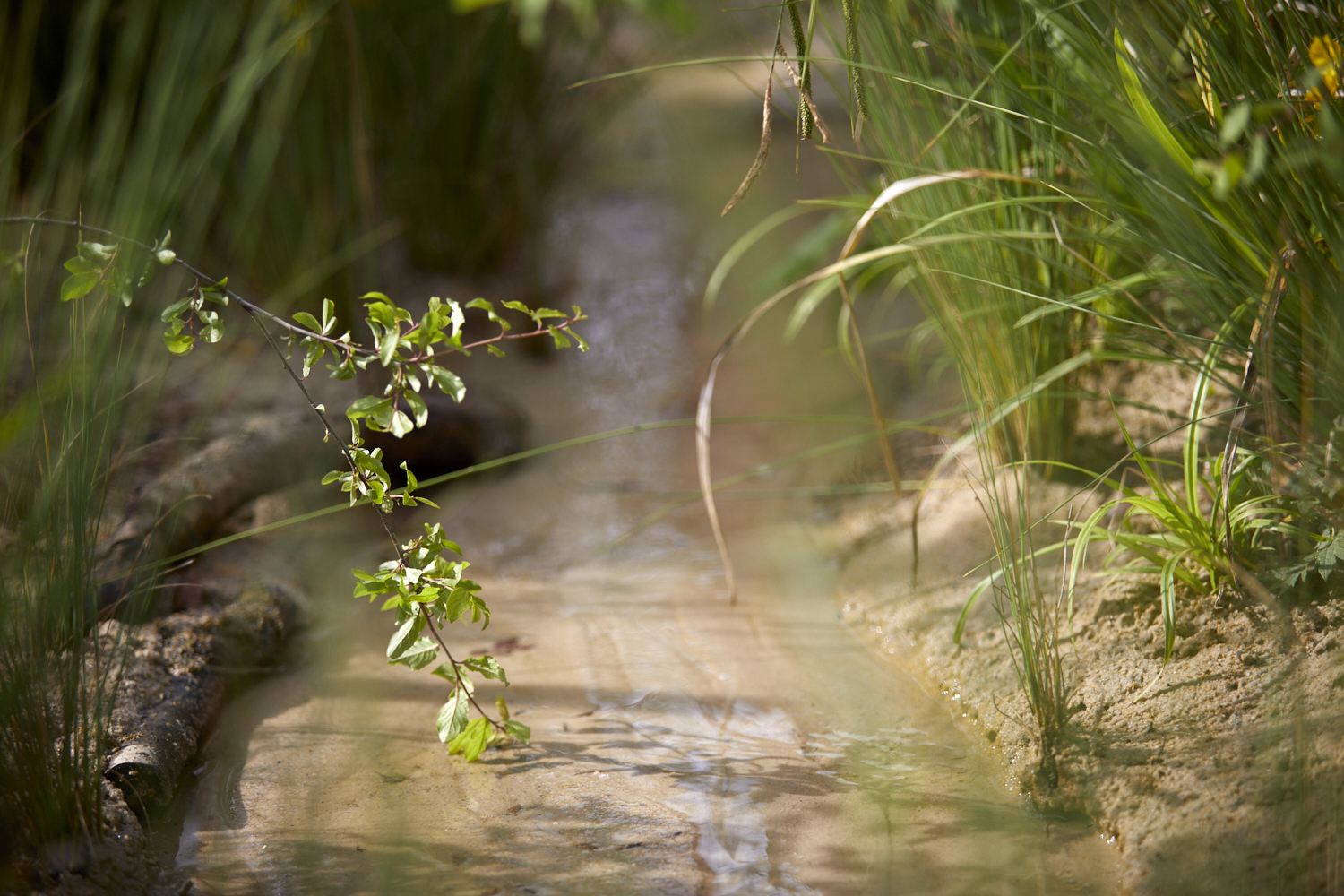
The plant list for the PGB garden is not composed of 'show' plants; in fact, there are no cultivars at all. Everything can be found already growing at the Roussillon ochre mine. Expect to find at least 24 pine trees and 40 dog roses, plus the tiniest species, which almost ask to be examined on one's knees (common whitlowgrass has petals that are 3-millimetres long). Prettiness and plant perfection is not the aim but there is natural elegance; native flowers include luminous field gladiolus, starry, white St Bernard's lily and small lilac drumsticks of Caucasian crosswort. "Because the land changes from one step to the next, from calcareous into a more acid sand landscape, the vegetation is dramatic, it's very showy. Hopefully, the vegetation will do the show thing, while demonstrating what can grow in that kind of material."
The other striking thing about the mines is their colour, an intense, and reverberating ochre. In varying hues of gold, orange and red, Guy Valentine and his team at Clayworks have used a lime render to cover metal structures that represent cliffs, even at the front of the garden. Because the original rocks are made of what is essentially ochre pigment, the show rocks need to resonate. Previous form has shown that James is adept at balancing spectacle with subtlety. "The lime render will be a very strong colour, using natural ochres," he explains. "The structures will be inspired by the rock, without trying to make a direct copy. Kind of like a Cézanne painting of those rocks, but in sculptural form."
The Project Giving Back garden is a 'feature garden' and will not be judged. This gives the designer a freer hand, and nobody will be marking him down for using, say, too much rock (two thirds of the ground plan is unplanted, sandy substrate). There is method to this; it's a way of challenging first impressions. Visitors will be drawn over by the theatre of the ochre-red cliffs, before looking down at what is going on at their feet. "There's a huge change in scale," explains James, "from the massive rock structures to the very delicate, dainty vegetation which manages to survive in this material."
Not everyone will like it. "I have no doubt that for some people who visit Chelsea, it won't speak to the aesthetic they're looking for," says Project Giving Back CEO, Hattie Ghaui. This is grist to the mill; PGB might keep a low profile, but it's not the sponsored gardens' intention. Controversy has benefitted charities, with the best-in-show, Rewilding Britain garden in PGB's debut year, a famous example. The ability to generate Chelsea hoo-ha, combined with the returns from more controllable fundraising events held by charities on the gardens during show week, has been a PGB success story. Through their Chelsea gardens alone, charities sponsored by Project Giving Back have been able to raise £20 million over the last four years.
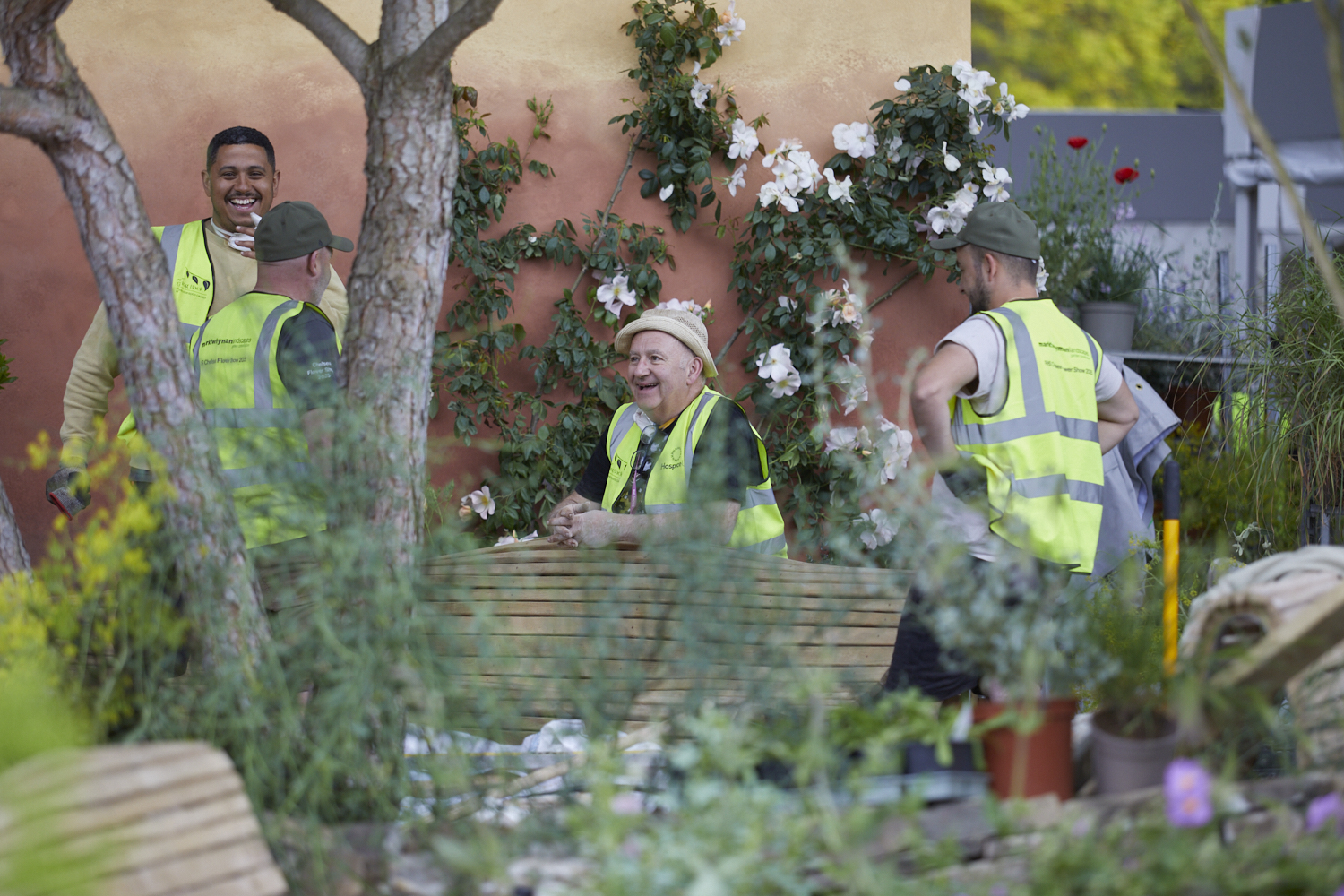
Two thousand plants, grown by Kelways, will be relocated from the Project Giving Back Garden to a volunteer-led greenspace in Cheshire, the Wonky Garden. Begun as a means of cancer recovery for its founder, Angela Hayler, it has grown into a garden that supports the wellbeing of a community. The theme of community and teamwork runs through all PGB-sponsored gardens, in both their first and second acts. Project Giving Back's 64th and final garden at RHS Chelsea has been built by Mark Whyman Landscapes and planted by professionals and skilled volunteers, led by horticulturalist Marc O'Neill. Its theme is, in the end, self-explanatory. "Anyone who does Chelsea owes it back, because of the people who help you make a garden," says James. "Everyone puts in 200 percent."

Last week, four members of the Project Giving Back team climbed the three highest peaks in the UK in support of Trussell, the UK’s anti-poverty charity with a network of foodbanks in England, Wales, Scotland and Northern Ireland. Trussell has a simple mission. To see a day when their vital services are no longer required.

Plants from The Project Giving Back Garden at RHS Chelsea Flower Show will take root at the Wonky Garden in Widnes.
Grant-making charity Project Giving Back (PGB) has announced seven of its final collection of gardens for good causes at RHS Chelsea Flower Show 2026. The remaining four gardens, all in the All About Plants category, will be announced in January 2026. From 2022 to 2026 PGB will have sponsored a total of 63 gardens for different charitable causes, all of which will be relocated or repurposed at sites around the UK.

The annual Gardens for Good Causes Exhibition at the Garden Museum in London will be open to visitors from 12 to 28 September, showcasing the ten charity gardens supported by Project Giving Back at this year’s RHS Chelsea Flower Show.

Project Giving Back has announced that it will fund five more gardens to raise awareness of UK-based causes at RHS Chelsea Flower Show 2025, bringing the total number of gardens it is supporting this year to ten. These include all four gardens in the All About Plants category, as well as one additional show garden designed by Nigel Dunnett.

Grant-making charity Project Giving Back (PGB) will fund a further cohort of gardens for UK charities at RHS Chelsea Flower Show 2025, all of which will be permanently relocated after the show to continue to benefit the good causes that have inspired them.

Project Giving Back supports gardens for good causes at the RHS Chelsea Flower Show, and while the deadline (Friday 4th October 2024) for the 2026 Show Garden funding applications has now passed, we’re pleased to announce that we will be extending the deadline for the 2026 All About Plants funding category to Monday 4th November 2024.

Project Giving Back supports gardens for good causes at the RHS Chelsea Flower Show, and we are excited to announce that we are open to applications for funding for all categories listed on our website for 2026.
The annual Gardens for Good Causes Exhibition will be on display at the Garden Museum in London from 13 - 29 September

Since Project Giving Back (PGB) started funding gardens for good causes at RHS Chelsea Flower Show in 2022, our unique grant-making charity has had a significant impact - not only on the world-famous flower show and the charities who have used the opportunity to raise funds and awareness, but also on the communities where the gardens find permanent homes after the show has closed. All 60 gardens PGB will fund between 2022 and 2026 will have a life after RHS Chelsea in permanent locations around the UK.
.jpg)
It is 30 years since Mark Fane built his first garden at the RHS Chelsea Flower Show and this year will be the last. As Crocus bows out of the show, Mark reflects on their incredible legacy of designer partnerships that have delighted show visitors and viewers and inspired a new generation of designers, landscapers and nursery folk.

On Tuesday 26 March 2024, Rosie Atkins received an RHS Elizabeth Medal of Honour (EMH), in recognition of her contribution to horticulture. Rosie talks about her career and what receiving the EMH means to her.
%20(2).jpg)
For the last 20+ years I’ve been celebrating IWD in the corporate world … a world where we’ve used the day to celebrate the progress and achievements being made. And that’s been important because, let’s face it, there are still today material discrepancies in the number of women in senior and leadership roles, and in gender pay. Corporates now recognise the issue and, in most cases, are working hard to address the imbalances. However, targets of 40% of women on Boards and an 8% gender pay gap shows there is still a long way to go, and it’s a nut that hasn’t been cracked.

We are delighted to be supporting all six of the All About Plants gardens at RHS Chelsea this May. These small gardens use the power of plants to highlight the work of some amazing charitable causes and showcase new designers and specialist growers and nurseries.

Project Giving Back exists to amplify the work of charitable causes in the UK. We fulfil our purpose by funding gardens for good causes at the RHS Chelsea Flower Show. The gardens are first a catalyst for engagement at the world-renowned Royal Horticultural Society Chelsea Flower Show, before being relocated or repurposed to permanent sites across the UK creating an ongoing legacy and benefit to the causes and their communities.

Trees, water and a heartwarming dose of joy were the main topics of conversation at the RHS Gardens for the Future press conference this week.

Project Giving Back (PGB) will support 15 gardens for good causes at RHS Chelsea Flower Show 2024, including seven show gardens and two sanctuary gardens that have been announced by the RHS today.

We are now accepting expressions of interest from charities and designers interested in applying to create a fully funded show garden at RHS Chelsea Flower Show 2025. This follows our recent announcement that Project Giving Back is extending its programme of funding for gardens for good causes until 2026. Here we explain in more detail the stages and timeline for the application process.

Project Giving Back (PGB) intends to continue its support of gardens for good causes at the RHS Chelsea Flower Show in 2025 and 2026. Expressions of interest for 2025 funding can be submitted via the Project Giving Back website from Friday 22 September to Friday 3 November 2023. All gardens supported by PGB are repurposed in permanent locations around the UK after the show as ongoing legacies for the causes that inspired them.

We are excited to be back at the Garden Museum in September with a two week exhibition celebrating the 15 gardens supported by PGB at the RHS Chelsea Flower Show 2023. All our 2023 gardens for good causes are being relocated to permanent homes throughout the UK.

My first visit to the RHS Chelsea Flower Show site during the build always blows my mind. With 25 show gardens this year, the compact site feels full of activity, machinery and a LOT of people in high vis.

Project Giving Back offers a form of creative philanthropy in which good causes receive a gift of opportunity rather than direct funding. Wide ranging benefits include opportunities for extensive press and social media coverage, hosting exclusive events for potential donors and direct engagement with thousands of show visitors. We asked our 2022 garden teams to tell us how their experience at RHS Chelsea 2022 has impacted their charity so far.

Every International Women’s Day, thousands of “Happy IWD” messages are sent and received. Don’t get me wrong, I’m at the front of the queue when it comes to wanting to celebrate the achievements of women, past, present and future, but when it comes to international anything day/week/month, ‘happy’ is not often what I feel. While I applaud organisations for using it as a vehicle for highlighting change still needed, every year, there’s a part of me that feels frustrated because the very existence of a day is evidence that equality is still being strived for.

Speaking at the PGB 2023 Exhibitor Workshop, Katie Tait, Director of Communications at Maggie’s and PGB Mentor, chats to some of our 2022 cohort about the challenges of running successful PR campaigns in the crowded Chelsea media space.

House Nine Design and Project Giving Back helped raise over £15,000 to help those fleeing domestic abuse through the charity Furnishing Futures.

We are delighted to reveal further good causes we will support next year with the announcement of the All About Plants and Sanctuary Gardens at RHS Chelsea Flower Show 2023.

Following a hugely successful inaugural year in 2022, we will support more gardens for good causes in 2023. They will be presented at the RHS Chelsea Flower Show, before being repurposed and relocated to their permanent homes across the UK. These include seven Show Gardens announced by the RHS. All gardens we support are inspired by UK charities and will live on after the show as a lasting legacy for their individual good causes - as teaching gardens, community spaces and other beneficial green spaces.

The Garden Museum will host a special exhibition, from 30 September - 6 October 2022, to celebrate the twelve gardens for good causes supported by Project Giving Back that were presented at RHS Chelsea Flower Show 2022.

To help applicants plan a submission for 2024 funding, we are sharing more information about the questions that will be asked in our expression of interest form.

From 1 - 23 September 2022, we will be inviting expressions of interest for garden funding at RHS Chelsea Flower Show 2024.

RHS Chelsea 2022 was a vintage year and Project Giving Back is proud to have played its part. Hattie Ghaui, CEO of Project Giving Back, reflects on the charity's first RHS Chelsea Flower Show, celebrates some of the incredible success stories, and looks ahead to the next milestone in the charity's Chelsea journey.

Hattie Ghaui has been appointed CEO of Project Giving Back, which is now a registered charity.

Once our charities and garden designers have had their design accepted by the RHS, then it’s all systems go. There is a huge amount of organisation involved in creating a show garden at RHS Chelsea Flower Show. As former RHS Chelsea Flower Show Manager and RHS Head of Shows Development, our advisory panel member Alexandra Denman is perfectly placed to provide insight into the many things that go into bringing together a successful show garden.

It is thanks to the generosity of our Founders that Project Giving Back exists to give good causes the opportunity to have a presence at RHS Chelsea Flower Show. Here our Project Director, Hattie Ghaui, explains more about how our gardens are funded.

When Project Giving Back was first conceived at the beginning of last year, Rosie Atkins was an obvious choice to be invited to get involved. Rosie began her career in journalism at the Sunday Times and 30 years ago launched Gardens Illustrated magazine. After ten years as editor, she left to become Curator of Chelsea Physic Garden. She has chaired various RHS committees and served on the boards of several charities. Here Rosie tells us what made her want to be part of Project Giving Back and why she thinks gardening and good causes are such a good fit.

We are thrilled to announce the good causes and designers behind four new All About Plants gardens, supported by Project Giving Back at the RHS Chelsea Flower Show 2022.

Project Giving Back will support 12 gardens for good causes at the RHS Chelsea Flower Show in May 2022. Today we can reveal seven of those gardens, with more to be announced later in January. All gardens supported by Project Giving Back will be unveiled to show visitors and viewers before being relocated to their permanent homes across the UK in summer 2022.

For the first time in the show’s 108-year history, the RHS Chelsea Flower Show was held in autumn this year. The sun shone all week and the whole experience was one of relaxed, late summer contentment. We popped along to discover more about how the greatest flower show on Earth offers an unparalleled platform for good causes to tell the world about their work.

We're so pleased to be able to announce a new and unique organisation that will provide funding for gardens inspired by UK charities and not-for-profit organisations at the RHS Chelsea Flower Show in 2022, 2023 and 2024.
© Project Giving Back 2023. Registered charity number 1198478. All Rights Reserved.